Heritage of Stokesley.
Stokesley has an important architectural heritage, consisting mainly of larger houses of the well-to-do, artisans' cottages, and small dwellings in wynds. Almost all the buildings are vernacular — a category now recognised as a valuable part of the architectural heritage. The town centre is protected by a Conservation Area containing many Grade I and Grade II listed buildings, which can be explored on the Stokesley Trail, available from the Parish Council office in the Town Hall.
Town Hall
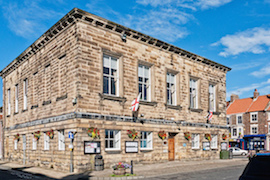
Stokesley Town Hall, an imposing building in the centre, was built in 1853 in the Italian style of architecture at the expense of Col. Robert Hildyard, replacing an older town house and toll booth. Originally this had an open arcade (butter market) at the rear.
The town centre is now protected by a Conservation Area with many Grade I and Grade II listed buildings. These can be explored following the 'Stokesley Trail', available from the Parish Council office in the Town Hall. The trail concludes with a peaceful riverside walk, as a contrast to the bustle of the High Street.
Miss Jane Pace / Mrs Jane Henty
South Levenside was planted with trees in 1934–35 in remembrance of Miss Jane Pace (afterwards Mrs S. Henty), born in Stokesley on 8th February 1817. She was the first white woman to settle permanently in Victoria, Australia, in 1836.
Economy & Industry
Stokesley had many industries including printing and publishing, weaving, and textile mills. The manufacture of linen was carried on here, extended by two mills — one built by Thomas Mease to be worked by steam, located on the banks of the Leven in the centre of town. This building is still in use today as an agricultural warehouse.
The Mill
The Domesday Book of 1086 records a water mill in Stokesley, with both water and horse-drawn wheels within the same building — an unusual feature for the period. The mill was demolished in 1983, but the Stokesley Society rescued the wheel (dating from around 1850), which is preserved on the banks of the River Leven as a relic of Stokesley's long association with milling.
Grammar School & College Square
The former Preston Grammar School was the first grammar school built in Stokesley, constructed in College Square in 1832 with money bequeathed by John Preston, an attorney of the town. The building is now home to a pizza takeaway — though its history is rather more distinguished.
Methodist Chapel
The first Methodist Chapel dated from 1765–1812, at which John Wesley preached on 11th July 1776 during one of his twelve visits to the town. According to his journal, the building 'would by no means contain the congregation'.
The White House
Traditionally the home where John Wesley stayed during his preaching visits. It was also the home of Lady Mary Hullock, under whose will the Lady Hullock's Charity was created in 1854 to provide fuel and clothing to the poor of the town.
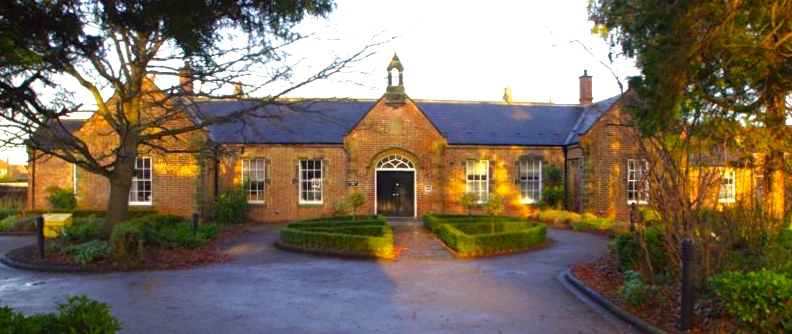
Stokesley had a parish workhouse accommodating fifty inmates in operation from as early as 1755 on High Green. Eventually, in 1847, the Stokesley Guardians built a new workhouse accommodating 104 inmates to the north-east of the town. It became a care home and closed in 2005, later redeveloped into retirement properties.
The Manor House
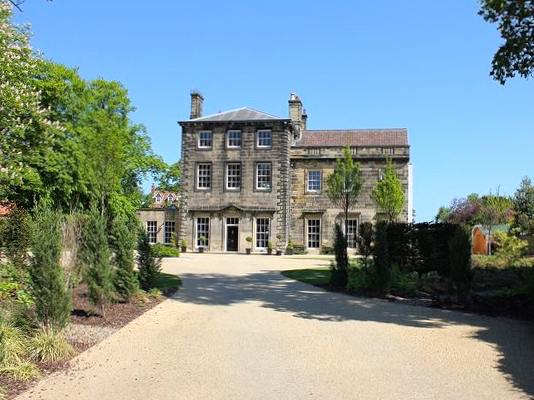
Stokesley Manor House is an imposing building at the eastern end of the Market Square. The gate piers came from Angrove Hall, which was demolished in 1832. Over the centuries it has served as a hospital, court house, and public library — it is now a private home again.
Stokesley Agricultural Show
Founded in 1859 with a meeting held at The Golden Lion on the High Street (now Chapters Hotel & Restaurant), the Stokesley Agricultural Show is held every year on the third Thursday in September — one of the oldest agricultural shows in the region.
The West Green area, with old buildings surrounding the green, forms a picturesque backdrop. The whole town provides planted floral tubs in the summer months to welcome visitors to the area.